
Types of Astrology Explained: Vedic, KP, Lal Kitab, Numerology, Tarot & More
A beginner’s guide to the different types of astrology — how they evolved, how they differ, and how Vedic astrology, the KP system, Lal Kitab, numerology, and tarot fit together.
Table of Contents
Astrology did not appear overnight. It developed independently in several civilizations, each shaping it according to their own philosophy, mathematics, and observation of the sky.
Ancient Mesopotamia (c. 3000 BCE) is widely credited as the birthplace of astrology. Babylonian priests tracked planetary movements and began associating them with omens for kings and kingdoms — the earliest form of what we’d now call astrology.
Vedic India (c. 1500 BCE onward) developed its own independent system, deeply rooted in the Vedas and later texts like Brihat Parashara Hora Shastra. This became the foundation of what we today call Vedic or Parashari astrology — a system built on the sidereal zodiac (based on the actual, observable position of stars) rather than the tropical zodiac used in the West.
Ancient Greece (c. 400 BCE) absorbed Babylonian astrology and refined it mathematically, giving us many of the concepts — like the twelve zodiac signs and horoscope casting — that Western astrology still uses today.
Medieval and later India produced two major offshoots that remain widely practiced:
- Lal Kitab, written by Pandit Roop Chand Joshi Ji from village Pharwala in Punjab. Its foundation lies in Vedic astrology itself, presented through a simplified chart format and practical, easy-to-perform remedies.
- KP System (Krishnamurti Paddhati), developed by the late K.S. Krishnamurti in the 20th century, which refined Vedic astrology using stellar (nakshatra) sub-lord theory for highly precise, event-based predictions.
Meanwhile, entirely separate divinatory traditions developed alongside astrology — numerology, rooted in Pythagorean and Chaldean number theory, and tarot, which emerged in 15th-century Europe as a card game before evolving into a symbolic divination tool in the 18th century.
So when someone says “astrology,” they could be referring to any of a dozen distinct types of astrology systems — each with its own logic, tools, and centuries of refinement behind it.
Astrology is the study of the relationship between celestial movements — the positions of the sun, moon, planets, and stars — and events on Earth, including human personality, behavior, and life events. At its core, astrology rests on a simple but profound idea: “As above, so below.” The cosmos and human life are not separate; they mirror and influence each other.
For over 25 years, I have practiced astrology professionally alongside a career as an export manager, and in that time I’ve seen one thing become very clear — astrology is not one single subject. It is an umbrella term for several distinct types of astrology, each with its own history, methodology, and strengths. Understanding these different systems is the first step for anyone genuinely curious about how astrology works, and it’s exactly what this post will walk you through.
- Astrology developed independently across Mesopotamia, India, Greece, and China — it is not one single tradition.
- The major types of astrology practiced today include Vedic (Parashari), KP system, Lal Kitab, Western, and Chinese astrology.
- Numerology and tarot are related but distinct divination systems, often used alongside astrology.
- Vastu Shastra is a related spatial science, not a predictive astrology system.
- Most experienced astrologers use more than one system together for a fuller, more practical analysis.
1. Parashari (Vedic) Astrology
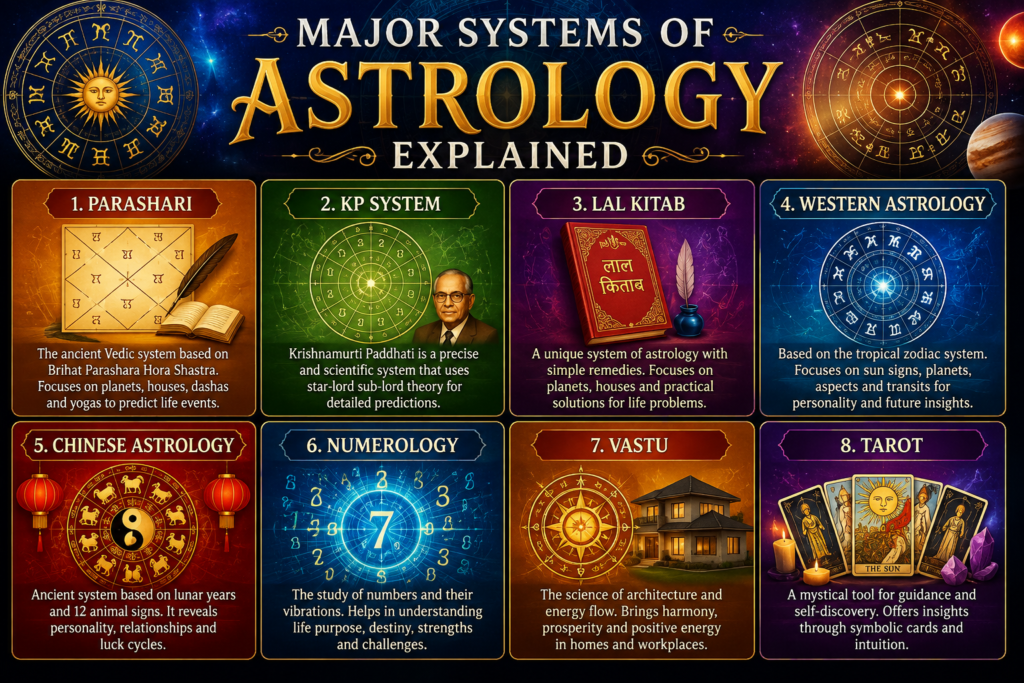
The foundational system of Indian astrology, based on the sidereal zodiac and the classical text Brihat Parashara Hora Shastra. It uses the birth chart (Kundli), planetary periods (Dashas), and divisional charts (Vargas) to analyze a person’s life in depth — career, marriage, health, wealth, and more. This is the system most people mean when they say “Vedic astrology.”
2. KP System (Krishnamurti Paddhati)
A more modern refinement of Vedic astrology, KP is known for its precision in event timing. It uses 249 sub-divisions of the zodiac (star lords and sub-lords) to answer specific yes/no questions — “Will I get this job?” or “When will I get married?” — with a level of exactness that traditional Parashari sometimes doesn’t offer.
3. Lal Kitab
Written by Pandit Roop Chand Joshi Ji from village Pharwala in Punjab, Lal Kitab is rooted in Vedic astrology but presents it through a simplified chart and highly practical, low-cost remedies (upay). Instead of complex calculations, it relies on an easy-to-read chart and is especially popular for solving real-world problems — debt, delays in marriage, family disputes — through remedies almost anyone can perform at home.
4. Western (Tropical) Astrology
The system most familiar to people in Europe and the Americas, based on the tropical zodiac (aligned with seasons, not fixed stars). It’s the source of the daily sun-sign horoscopes seen in newspapers and magazines. It differs from Vedic astrology mainly in its zodiac reference point and its psychological, rather than predictive, emphasis.
5. Chinese Astrology
An entirely separate system based on a 12-year animal cycle (Rat, Ox, Tiger, and so on) combined with the five elements (Wood, Fire, Earth, Metal, Water). It’s tied closely to the Chinese lunar calendar and is used for compatibility, yearly forecasts, and personality traits.
6. Numerology
Not astrology in the strictest sense, but closely related and often practiced alongside it. Numerology studies the vibrational significance of numbers derived from a person’s birth date and name to reveal personality traits, life path, and favorable timings. Both Vedic (Chaldean) and Western (Pythagorean) numerology systems are widely used today.
7. Tarot
A card-based divination system using a 78-card deck (22 Major Arcana and 56 Minor Arcana). Unlike astrology, tarot doesn’t rely on planetary positions — it’s typically used for intuitive guidance on specific questions or situations, often as a complement to astrological consultations rather than a replacement.
8. Vastu Shastra
Technically an architectural and design science rather than a predictive system, Vastu Shastra is the ancient Indian counterpart to Feng Shui. It deals with the directional and spatial arrangement of homes and workplaces to align them with natural energies, and is often consulted alongside astrology when addressing issues in career, health, and relationships.
Why So Many Systems? And Which One Is "Right"?
A common question I get is: “With so many types of astrology systems, which one is correct?”
The honest answer is that these systems aren’t necessarily competing — they’re different lenses on the same underlying reality, developed by different cultures with different tools and priorities. In my own practice, I don’t rely on just one system. A Parashari chart might show the broad life pattern, KP can help time a specific event with precision, Lal Kitab can offer a simple remedy the client can start using immediately, and Vastu might address an environmental factor that’s been working against the person for years. Used together, thoughtfully, they complement each other far more than they conflict.
This is also, honestly, the advantage of consulting an astrologer who has trained across multiple systems rather than just one — the analysis becomes more layered and the remedies more practical.
Frequently Asked Questions About Types of Astrology
What are the main types of astrology? The main types of astrology are Vedic (Parashari) astrology, the KP system, Lal Kitab, Western (tropical) astrology, and Chinese astrology. Numerology and tarot are closely related divination systems often practiced alongside astrology, and Vastu Shastra is a related spatial science.
What is the difference between Vedic and Western astrology? Vedic astrology uses the sidereal zodiac, based on the actual observable position of the stars, while Western astrology uses the tropical zodiac, based on the seasons. This difference means the same birth date can map to a different zodiac sign in each system.
Is Lal Kitab part of Vedic astrology? Yes. Lal Kitab is rooted in Vedic astrology. It was written by Pandit Roop Chand Joshi Ji from village Pharwala in Punjab, and presents Vedic principles through a simplified chart with practical, easy-to-perform remedies.
What is the KP system of astrology used for? The KP (Krishnamurti Paddhati) system is used mainly for precise, event-based predictions — such as timing a job offer, marriage, or property purchase — using stellar sub-lord theory to narrow down outcomes more specifically than traditional Vedic methods.
Can numerology and tarot be used alongside astrology? Yes. Many practitioners use numerology and tarot as complementary tools alongside a birth chart reading, though both are technically separate systems from astrology itself.
What's Next on This Blog
This post is meant as a foundation for understanding the different types of astrology before going deeper into any one of them. In the coming weeks, I’ll be publishing deeper, practical guides on:
- How Vedic astrology charts are actually read
- KP system predictions and how sub-lords work
- Lal Kitab remedies for common problems (debt, delayed marriage, career blocks)
- Vastu corrections for home and office
- How to use numerology alongside your birth chart
If you’re dealing with a specific concern — career stagnation, delayed marriage, financial loss, or health issues — feel free to reach out for a consultation. Sometimes the right combination of a chart reading and a simple remedy can make a real difference.
Have a specific astrology question you’d like this blog to cover? Let us know in the comments or reach out directly.
A beginner’s guide to the different types of astrology — how they evolved, how they differ, and how Vedic astrology, the KP system, Lal Kitab, numerology, and tarot fit together.